
Why Asia Sells Shampoo One Wash at a Time
Around 855 billion single-use packets are sold every year, nearly half of them in Southeast Asia. Why selling shampoo one wash at a time makes sense when money arrives by the day, when it turns into a tax on being poor, and who pays for the plastic.
Read the transcript · 1,161 words
One wash at a time
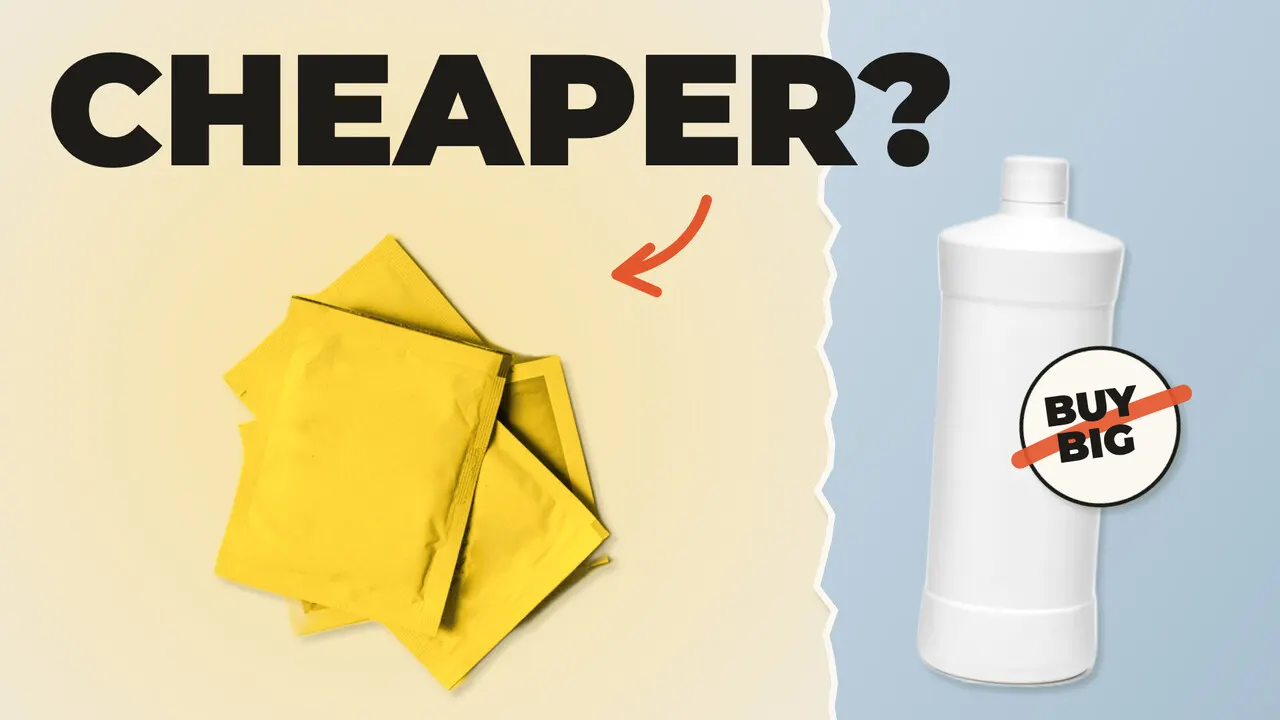
You've always been told that buying big saves money. This tiny packet says otherwise. In one price check in the Philippines, conditioner in a single-wash packet cost less per milliliter than the same conditioner in a bottle. And this isn't a niche habit. Every year, the world buys around eight hundred fifty-five billion of these little packets. Nearly half of them in Southeast Asia alone.
So why would anyone sell shampoo one wash at a time? The answer has less to do with packaging, and more to do with how money moves when you get paid by the day. And why does the very same idea, in other parts of the world, become a tax on being poor?
855 billion packets
These packets are called sachets, and once you notice them, you see them everywhere. Shampoo. Three-in-one coffee. Laundry powder. Fish sauce. Toothpaste. In the Philippines alone, people use around one hundred sixty-three million sachets every single day. That is roughly sixty billion a year, in a country of just over a hundred million people.
To a Western shopper, all of this looks backwards. Everything we learn says go big. The family-size bottle. The warehouse club. The twelve-pack. So either half the planet is bad at shopping, or something else is going on. To find out, we have to go back to a small town in southern India, in the nineteen seventies.
The man who invented it
In Cuddalore, in Tamil Nadu, a farmer who also packed medicines, Chinni Krishnan, noticed something simple. Shampoo existed in India, but only the wealthy used it. A full bottle cost more than a laborer could set aside. So he asked a different question: what if you didn't have to buy the whole bottle?
He rigged together his own packing machine, starting from a device built to seal plastic folders, and began filling tiny packets. His family sold a shampoo sachet for two rupees.
Krishnan died in nineteen seventy nine, at just forty eight, before the idea really took off. But his youngest son, C. K. Ranganathan, pushed it further. In the early nineteen eighties he launched a brand named after his father's initials: Chik. And he priced it at half a rupee, a quarter of what other sachets cost.
Then he did something clever. Bring back a handful of empty sachets, and get one Chik free. Shop owners loved it. Customers switched.
Within a generation, the global giants copied the model. By the early two thousands, sachets made up about seventy percent of shampoo sales in India's cities, and around ninety percent in the countryside. The packet had gone from a village experiment to the default way a billion people bought soap.
Paid by the day
Here is the part most explanations miss. The sachet is not really about being cheap. It is about being small.
If you earn a monthly salary, you can spend ten dollars once and not think about it for weeks. But in large parts of Asia, many people are paid by the day. A street vendor, a construction worker, a motorbike driver. Money comes in daily, and it goes out daily. At one point, one in four Filipinos lived on around one US dollar a day.
On that budget, a full bottle of shampoo isn't expensive. It's impossible. Not because of the price per milliliter, but because of the price per purchase. You simply never have that much spare cash at one moment.
And there are other reasons small wins. Homes are small and shared, so there is nowhere to store a month of supplies. Many people shop at a corner store a few steps away, not a supermarket a drive away. And buying in tiny amounts is old. Long before plastic, shops across the region sold goods by the scoop, the cup, the single cigarette.
The sachet just packaged a habit that already existed.
When small is cheaper
So the sachet wins on size, not on price. Now you might expect the catch. Surely the poor pay more for buying in tiny pieces?
Sometimes, it's the opposite. In one price check in the Philippines, a popular conditioner cost thirty-six centavos per milliliter in a sachet. The same conditioner in a one-hundred-eighty milliliter bottle? Forty-seven centavos. About thirty percent more for buying bigger.
Why would a company do that? Because in markets like this, the sachet isn't the side product. It is the product. One Unilever executive estimated that sixty to seventy percent of the country's shampoo was sold in sachets. That is where the volume is, and where the fiercest competition is. So that is where prices get pushed down.
The bottle, meanwhile, becomes something else. It's a small status upgrade. A sign you are doing well enough to buy ahead. And people will pay a little extra for that feeling.
The poverty premium
But don't assume the sachet is always a bargain. A study of laundry detergent in Ghana, Côte d'Ivoire and Cameroon found the opposite pattern. Packs of fifty grams or less cost, on average, about twenty five percent more per kilo than larger packs. Economists call it the poverty premium.
There's a twist in that story too. Before the brands made mini packs, market traders did it themselves. They bought big bags, split them up, and resold the pieces at a markup. The companies saw an opportunity, and started packing small in the factory. The middleman disappeared. The markup didn't.
So the sachet can be a deal, or a tax on being poor. It depends on how much competition there is, and who is doing the splitting.
The hidden bill
There is one cost that never shows up on the price tag.
A sachet is usually several thin layers fused together: plastic, sometimes aluminum, sometimes paper. That's what keeps the shampoo fresh in tropical heat. It is also why almost no one can recycle it. A plastic bottle has scrap value; a collector can sell it. A used sachet is worth nothing, so nobody picks it up.
Companies have tried. One Philippine take-back program in the twenty tens collected somewhere between four and ten million sachets a year. In a country using around sixty billion. That is fewer than one packet in every six thousand.
And the numbers are still climbing. Environmental groups project global sachet sales could reach one point three trillion a year by twenty twenty seven.
Why it isn't going away
So why does Asia sell everything in tiny packs? Not because people can't do math. Because when money arrives one day at a time, the smartest price is the one you can pay today.
The sachet is a brilliant answer to a cash problem. It gave billions of people access to products that used to be for the rich. But it also turned a cash problem into a trash problem. And until daily incomes change, that strip of packets in the shop doorway isn't going anywhere.
Next time, we'll look at another everyday mystery from this part of the world. In the meantime, tell me in the comments: what do people buy in tiny amounts where you live?
Every number, sourced
Each figure in the episode comes from this fact sheet. Spotted an error? Tell us and we will fix the page and pin a correction under the video.
- F1Global sachets sold per year~855 billion; Southeast Asia ~half; projected 1.3 trillion by 2027Phys.org / SciDev, 2024
- F2Philippines daily sachet use~163 million a day, ~60 billion a year (GAIA study)SCMP
- F3Sachet pioneerChinni Krishnan, Cuddalore, Tamil Nadu; agriculturist who also packed medicines; first sealer from a modified PVC-folder sealing machine and a transparent garden hose; died 1979 aged 48Madras Musings
- F4Early sachet priceFamily's Velvette sachet sold at Rs 2Madras Musings
- F5Chik shampooSon C.K. Ranganathan; name from father's initials; sold at 50 paise when rivals charged Rs 2ICMR case study
- F6Chik promotionReturn empty sachets for a free Chik; terms vary by source (4 or 5, Chik-only or any brand), so the script stays vagueNextBillion, Scribd case study
- F7India shampoo in sachetsBy 2004: ~70% of shampoo sales in cities, ~90% in rural India (Saabira Chaudhuri, Consumed)Kathmandu Post, 2025
- F8Sachet cheaper per ml (Philippines)Sunsilk conditioner: P0.36/ml sachet vs P0.47/ml in 180 ml bottle (~30% more)Rappler
- F9Share of shampoo in sachets (Philippines)60–70%, Unilever exec estimateRappler
- F10Daily income context1 in 4 Filipinos lived on about $1 (P46) a day, around 2012Rappler
- F11Poverty premium (Africa)Detergent packs ≤50 g cost ~25% more per kg on average in Ghana, Côte d'Ivoire, CameroonErasmus Univ., 2021
- F12Brands replaced the middlemanTraders used to split big packs and resell; brands now pack small themselvesErasmus Univ., 2021
- F13RecyclingMultilayer sachets have almost no scrap value; collectors skip themMina News
- F14Cleanup attemptsUnilever's 2012 Sachet Recovery Program collected 4–10 million a year vs ~60 billion produced (≤ 1 in 6,000)Wilson Center
- F15Buying small predates plastic"Tingi" small-quantity buying existed before sachetsPhys.org
- F16Philippines population109,035,343 (1 May 2020 census)PSA 2020 CPH
Get the next episode by email
One small thing from daily life in Asia and the system behind it, every other Friday. Unsubscribe in one click.